<?xml version="1.0" encoding="utf-8"?><feed xmlns="http://www.w3.org/2005/Atom" ><generator uri="https://jekyllrb.com/" version="3.10.0">Jekyll</generator><link href="https://photonicsarul.github.io/feed.xml" rel="self" type="application/atom+xml" /><link href="https://photonicsarul.github.io/" rel="alternate" type="text/html" /><updated>2026-05-07T16:38:33+00:00</updated><id>https://photonicsarul.github.io/feed.xml</id><title type="html">Rakesh Arul / Nanophotonics &amp;amp; Optoelectronics</title><subtitle>personal description</subtitle><author><name>Rakesh Arul</name><email>ra554@cam.ac.uk</email></author><entry><title type="html">Molecular vibrations march in sync within plasmonic nanogaps - editor’s highlight in Phys Rev Lett</title><link href="https://photonicsarul.github.io/posts/2025/08/PRLEditorsSugg/" rel="alternate" type="text/html" title="Molecular vibrations march in sync within plasmonic nanogaps - editor’s highlight in Phys Rev Lett" /><published>2025-08-15T00:00:00+00:00</published><updated>2025-08-15T00:00:00+00:00</updated><id>https://photonicsarul.github.io/posts/2025/08/APSVibSyncEditor</id><content type="html" xml:base="https://photonicsarul.github.io/posts/2025/08/PRLEditorsSugg/"><![CDATA[<p><img src="/images/PRLEditorsSugg.png" alt="Illustration" class="align-center" width="600px" /></p>

<p>First corresponding author paper with the NanoPhotonics Centre, highlighting Fiona’s project (a gargantuan effort by her and the team to build a new experimental ultrafast rig - and succeeding!).
Now published in <a href="https://journals.aps.org/prl/abstract/10.1103/txdw-nqvn">Physical Review Letters</a> and with an Editor’s highlight too!</p>

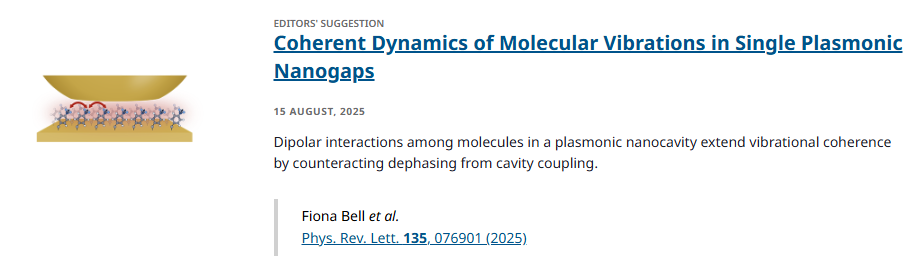
<p>Molecules are in constant motion at room temperature. Molecular vibrations typically decohere rapidly at room temperature, each molecule jostled out of step by its noisy environment. Yet coherent vibrational motion holds promise for next-generation optoelectronic, catalytic, and sensing applications. Now, Bell et al. demonstrate a striking phenomenon: molecular vibrations can spontaneously synchronize when molecules are densely packed in a plasmonic nanogap - a tiny cavity that confines optical fields to the nanoscale.</p>

<p>By monitoring the decay of vibrational modes, Bell et al. observe interference patterns that emerge only when vibrational modes are shared across multiple molecules, analogous to the acoustic beating of two tuning forks sounding together. These “beating” signals are signatures of coherent vibrational coupling, and crucially, they vanish when intermolecular interactions are suppressed. The study reveals that such coupling enhances vibrational coherence by over 200%, with the quantum state of the vibration delocalized across multiple molecules.</p>

<p>This discovery points to a new route for controlling vibrational coherence in room-temperature molecular systems, with wide-ranging implications. From boosting the efficiency of hot-electron-driven chemical reactions to tailoring the photoluminescence of organic emitters and engineering improved infrared photodetectors, the ability to engineer collective vibrational coherence opens new directions for molecular quantum technologies.</p>]]></content><author><name>Rakesh Arul</name><email>ra554@cam.ac.uk</email></author><category term="Mid-IR" /><category term="Synchronization" /><summary type="html"><![CDATA[]]></summary></entry><entry><title type="html">EPSRC-NSF joint grant awarded for quantum science and photonics</title><link href="https://photonicsarul.github.io/posts/2025/07/NanoSPINEC/" rel="alternate" type="text/html" title="EPSRC-NSF joint grant awarded for quantum science and photonics" /><published>2025-07-04T00:00:00+00:00</published><updated>2025-07-04T00:00:00+00:00</updated><id>https://photonicsarul.github.io/posts/2025/07/NanOSPINECgrant</id><content type="html" xml:base="https://photonicsarul.github.io/posts/2025/07/NanoSPINEC/"><![CDATA[<p><img src="/images/NanoSPINEC.jpg" alt="Illustration" class="align-center" width="600px" /></p>

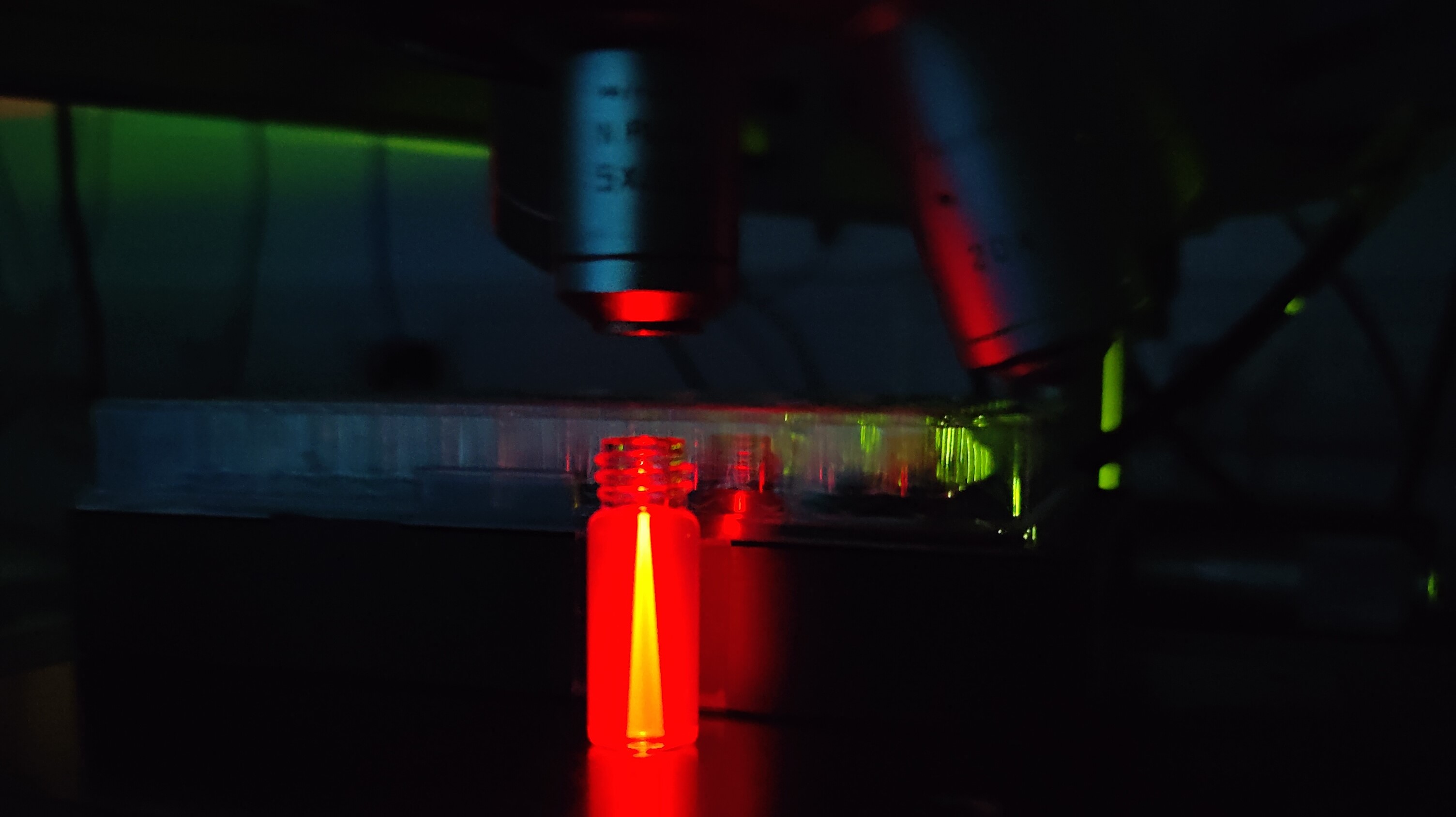
<p>Happy to receive a new grant worth half a million pounds to lead an exciting collaboration between three different areas of the Cavendish - optoelectronics, nanophotonics, and quantum optics. 
This grant, with an equal amount awarded to our theory collaborators &amp; partners in UCSD (Prof. Joel Yuen-Zhou) will run for three years and involve us trying to tackle a hard problem: how entangled are molecular excitons and how can we measure it!
Will be recruiting for a new postdoc soon and setting up a new laboratory and new experimental rig to measure single molecule optically detected magnetic resonance - stay tuned!
More details in news coverage by <a href="https://www.joh.cam.ac.uk/about-us/news-and-research/new-ps500-000-funding-for-quest-to-solve-scientific-mysteries">St. John’s College Cambridge</a>	
and the <a href="https://www.phy.cam.ac.uk/news/cavendish-researchers-awarded-funding-to-advance-quantum-science-combined-with-chemistry/">Cavendish Laboratories</a>.</p>]]></content><author><name>Rakesh Arul</name><email>ra554@cam.ac.uk</email></author><category term="Quantum" /><category term="NanoSPINEC" /><summary type="html"><![CDATA[]]></summary></entry><entry><title type="html">Conferences 2025 - SPP11 and SCOM5</title><link href="https://photonicsarul.github.io/posts/2025/07/conferences2025/" rel="alternate" type="text/html" title="Conferences 2025 - SPP11 and SCOM5" /><published>2025-07-01T00:00:00+00:00</published><updated>2025-07-01T00:00:00+00:00</updated><id>https://photonicsarul.github.io/posts/2025/07/Conferences25</id><content type="html" xml:base="https://photonicsarul.github.io/posts/2025/07/conferences2025/"><![CDATA[<p>Had a fun time this year at the <a href="https://spp11.tokyo/invited-speakers/">SPP11</a> conference in Tokyo, giving my first invited talk on “Nanophotonics to control mid-infrared light and polariton condensation” and giving a contributed talk in <a href="https://www.sdu.dk/en/forskning/polima/scom5">SCOM5</a> on the new lanthanide research direction. 
Good feedback and great to see scientific colleagues and learn from the community - and get new ideas!</p>]]></content><author><name>Rakesh Arul</name><email>ra554@cam.ac.uk</email></author><category term="conferences" /><summary type="html"><![CDATA[Had a fun time this year at the SPP11 conference in Tokyo, giving my first invited talk on “Nanophotonics to control mid-infrared light and polariton condensation” and giving a contributed talk in SCOM5 on the new lanthanide research direction. Good feedback and great to see scientific colleagues and learn from the community - and get new ideas!]]></summary></entry><entry><title type="html">Single molecule mid-IR spectra! - News &amp;amp; Views by Nature Photonics</title><link href="https://photonicsarul.github.io/posts/2023/09/MIRVALS/" rel="alternate" type="text/html" title="Single molecule mid-IR spectra! - News &amp;amp; Views by Nature Photonics" /><published>2023-09-29T00:00:00+00:00</published><updated>2023-09-29T00:00:00+00:00</updated><id>https://photonicsarul.github.io/posts/2023/09/NatPhotNewsViews</id><content type="html" xml:base="https://photonicsarul.github.io/posts/2023/09/MIRVALS/"><![CDATA[<p><img src="/images/MIRVALS.png" alt="Illustration" class="align-center" width="600px" /></p>

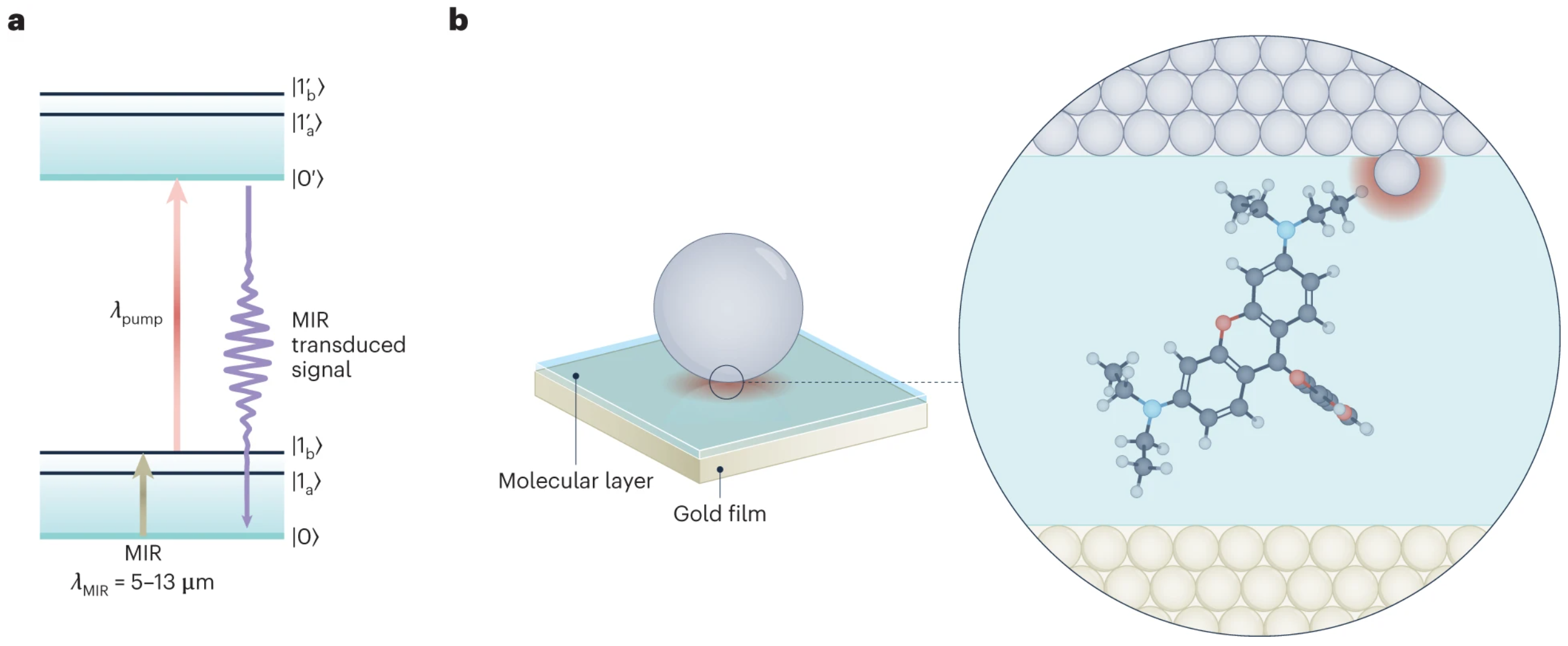
<p>Our long effort on single-molecule upconversion to transduct mid-IR vibrational signals to the visible via mid-infrared vibrationally assisted luminescence (MIRVAL)
is published in Nature Photonics, with a nice News &amp; Views by Matthew Sheldon from Texas A&amp;M. 
<a href="https://www.nature.com/articles/s41566-023-01289-8">News &amp; Views</a></p>]]></content><author><name>Rakesh Arul</name><email>ra554@cam.ac.uk</email></author><category term="MIRVALS" /><category term="Upconversion" /><category term="Mid-infrared" /><category term="Single molecule" /><summary type="html"><![CDATA[]]></summary></entry><entry><title type="html">Cambridge-Exeter collaboration on polaritons published - editor’s highlight in Phys Rev Lett</title><link href="https://photonicsarul.github.io/posts/2023/09/Cambridge-Exeter/" rel="alternate" type="text/html" title="Cambridge-Exeter collaboration on polaritons published - editor’s highlight in Phys Rev Lett" /><published>2023-09-22T00:00:00+00:00</published><updated>2023-09-22T00:00:00+00:00</updated><id>https://photonicsarul.github.io/posts/2023/09/APSgratinghighlight</id><content type="html" xml:base="https://photonicsarul.github.io/posts/2023/09/Cambridge-Exeter/"><![CDATA[<p><img src="/images/GratingImage.png" alt="Illustration" class="align-center" width="600px" /></p>

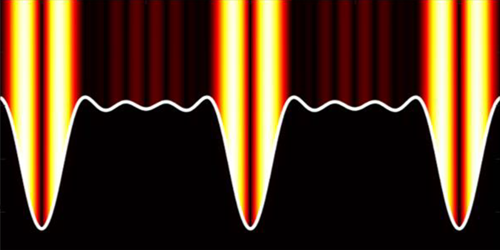
<p>A collaboration between the NanoPhotonics Centre in Cambridge and Bill Barnes’ team in Exeter over few years lead to us 
understanding the fundamentals of interaction between polaritons and molecular vibrations within open cavity systems. 
Fun to discover new physics in a system studied since the time of Lord Rayleigh! 
Further details in the press links below from the <a href="https://www.phy.cam.ac.uk/news/cambridge-scientists-unlock-ultra-strong-light-matter-coupling-paving-the-way-for-revolutionary-material-transformations/">Cavendish Laboratory</a> and <a href="https://physics.aps.org/articles/v16/s130">APS</a>.</p>]]></content><author><name>Rakesh Arul</name><email>ra554@cam.ac.uk</email></author><category term="Collaborations" /><category term="Polaritons" /><category term="Mid-infrared" /><summary type="html"><![CDATA[]]></summary></entry></feed>