Molecular vibrations march in sync within plasmonic nanogaps - editor’s highlight in Phys Rev Lett
Published:
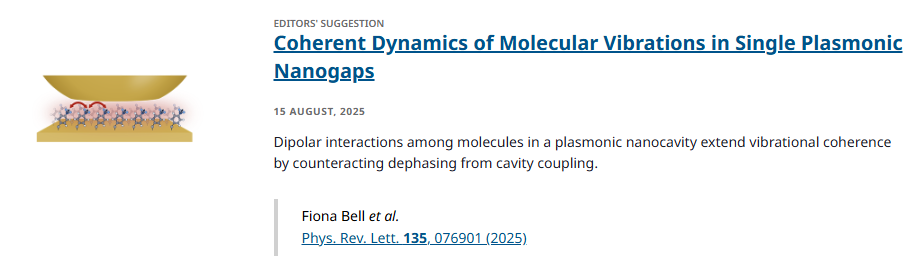
First corresponding author paper with the NanoPhotonics Centre, highlighting Fiona’s project (a gargantuan effort by her and the team to build a new experimental ultrafast rig - and succeeding!). Now published in Physical Review Letters and with an Editor’s highlight too!
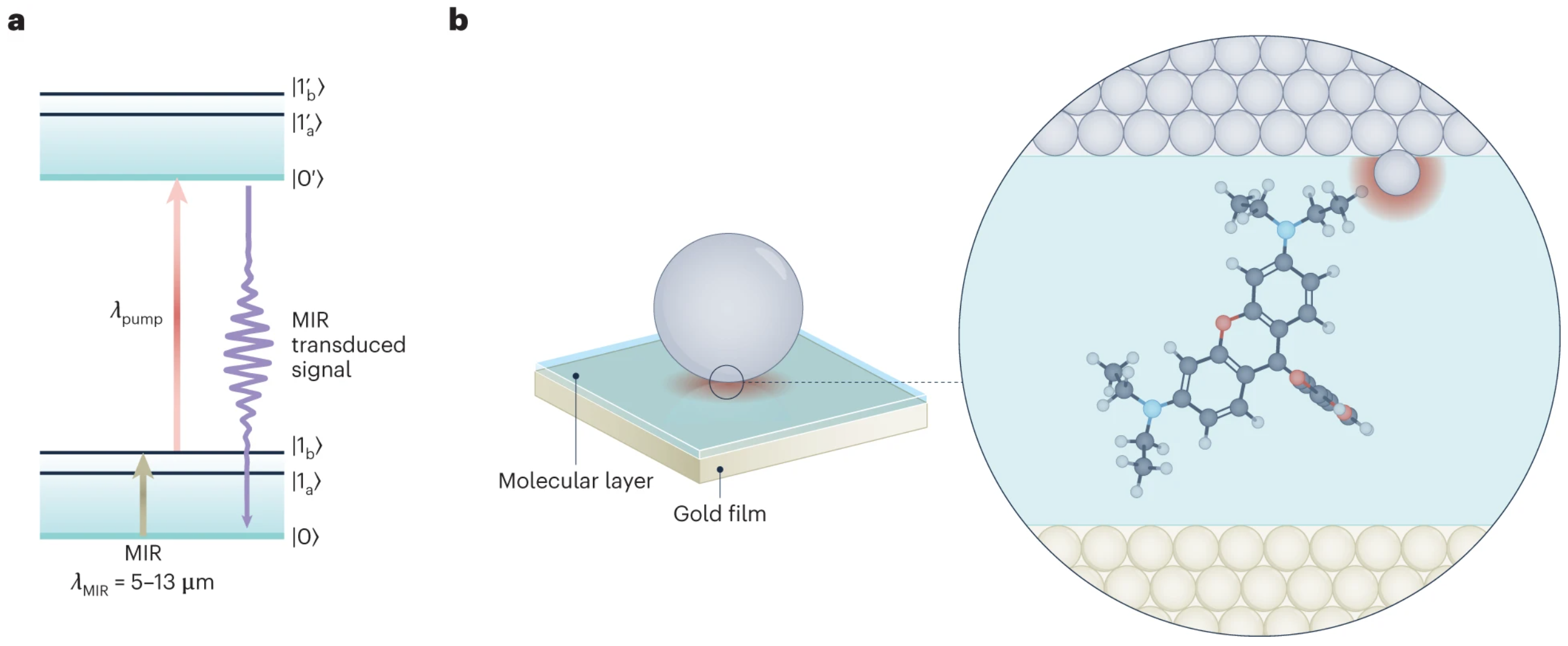
Molecules are in constant motion at room temperature. Molecular vibrations typically decohere rapidly at room temperature, each molecule jostled out of step by its noisy environment. Yet coherent vibrational motion holds promise for next-generation optoelectronic, catalytic, and sensing applications. Now, Bell et al. demonstrate a striking phenomenon: molecular vibrations can spontaneously synchronize when molecules are densely packed in a plasmonic nanogap - a tiny cavity that confines optical fields to the nanoscale.
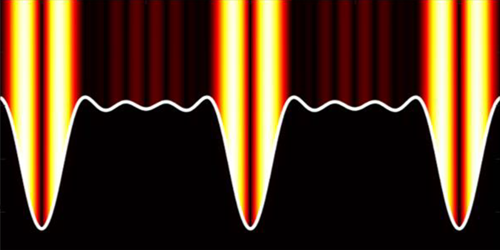
By monitoring the decay of vibrational modes, Bell et al. observe interference patterns that emerge only when vibrational modes are shared across multiple molecules, analogous to the acoustic beating of two tuning forks sounding together. These “beating” signals are signatures of coherent vibrational coupling, and crucially, they vanish when intermolecular interactions are suppressed. The study reveals that such coupling enhances vibrational coherence by over 200%, with the quantum state of the vibration delocalized across multiple molecules.
This discovery points to a new route for controlling vibrational coherence in room-temperature molecular systems, with wide-ranging implications. From boosting the efficiency of hot-electron-driven chemical reactions to tailoring the photoluminescence of organic emitters and engineering improved infrared photodetectors, the ability to engineer collective vibrational coherence opens new directions for molecular quantum technologies.